
Somewhere between INBOUND 2025 and the next time you opened the pricing page, Operations Hub stopped existing under that name. It is Data Hub now. The subscription did not change, the features did not disappear, and everything written about Operations Hub before the rename still broadly applies, which is exactly why the change is confusing rather than clarifying.
This guide covers what the product is, what the rename actually changed, what each tier costs and unlocks, and the specific class of problem that no tier on the ladder solves.
In this article
1.
2.
3.
4.
5.
6.
7.
8.
9.
What HubSpot Operations Hub is
Operations Hub was HubSpot's answer to a problem the other hubs create. Marketing Hub, Sales Hub, and Service Hub each give a team a job to do inside the CRM. None of them address the state of the data those teams are working on: where it came from, whether it agrees with the system it came from, and whether it is clean enough to trust.
Operations Hub was that layer. Three things defined it, and all three survive under the Data Hub name.
Data sync
The native engine that keeps records consistent between HubSpot and another app. It powers more than 100 Marketplace integrations and it is configuration rather than code. Covered in depth in HubSpot data sync.
Programmable automation
Custom coded actions inside workflows, plus webhooks. This is where HubSpot workflows stop being a point-and-click builder and start being something an engineer can extend.
Data quality tooling
Duplicate management, formatting rules, validation, and a command center that surfaces what is wrong before someone reports it.
What the Data Hub rename actually changed
Calling it a rebrand undersells it slightly, and calling it a new product oversells it considerably. The honest version sits in between: the product line continued, the positioning shifted, and a handful of genuine additions arrived alongside the new label.
| What | Before (Operations Hub) | After (Data Hub) |
|---|---|---|
| Positioning | A toolkit sold to ops and RevOps teams | A data foundation pitched at marketing, sales, and service as well |
| Data sync | Core feature, free tier included | Unchanged, still the free tier headline |
| Programmable automation | Professional and above | Unchanged |
| Data quality | Duplicate management, formatting, the command center | Extended with AI-assisted monitoring, cleanup, and enrichment |
| Datasets | Enterprise feature for reporting | Expanded into Data Studio, including bringing outside data in for AI context |
| Your subscription | Whatever you were on | The same thing, relabeled |
The through-line is that HubSpot is preparing the data layer for AI features that need trustworthy, well-shaped records to be useful. That is the real reason a technical ops product got repositioned as something everyone should care about. An assistant that reasons over a CRM full of duplicates and half-filled properties produces confident nonsense, and HubSpot knows it.
The rename is a bet that data quality stopped being an ops concern the moment AI started reading the CRM.
HubSpot Data Hub pricing
Four tiers, and the interesting thing about them is that the steps are uneven. The distance from Free to Starter is small enough to be an afterthought. The distance from Starter to Professional is a budget conversation.
| Tier | Price | Seats | Credits |
|---|---|---|---|
| Free | $0/mo | Up to 2 users | None |
| Starter | $7/mo per seat | Priced per seat | 500 HubSpot Credits |
| Professional | $720/mo | 1 Core Seat, $45/mo each additional | 5,000 HubSpot Credits |
| Enterprise | $2,000/mo | 1 Core Seat, $75/mo each additional | 10,000 HubSpot Credits |
What each tier unlocks
- 1
Free: two-way sync on default mappings
Connect a supported app from the App Marketplace, pick a source table, choose a direction, and turn it on. Historical records are reconciled on the first pass, not just new ones. For up to two users this costs nothing, and for a small team syncing contacts or companies it is frequently the whole solution.
- 2
Starter: custom field mappings
The first real paywall. Default mappings work when your source table looks like something HubSpot already models. The moment you want a column to land on a property HubSpot did not ship, you need custom mappings, and that is Starter. Also brings list segmentation and additional dashboards.
- 3
Professional: automation and data quality
Programmable automation (custom coded actions in workflows), webhooks, and data quality automation covering duplicate management, formatting, and validation rules. This is the tier for teams whose data problems are recurring and whose fixes are currently manual.
- 4
Enterprise: Data Studio and advanced prep
Datasets, advanced data prep, and Snowflake data sharing, now framed as Data Studio. Bought by organizations whose reporting requirements have outgrown HubSpot native reporting and who need to bring outside data in for analysis and AI context.
The pattern worth noticing: each tier buys you more control over fields. Better mapping of them, better automation on them, better analysis of them. That is the axis the whole product runs along, and it is the reason the next section exists.
Data Hub vs the other HubSpot hubs
A useful way to place it is by asking what breaks without it.
A Data Hub problem sounds like
- Two systems disagree about the same record
- Duplicates keep appearing and nobody catches them
- A property is always empty because filling it is manual
- Reporting needs data that lives outside HubSpot
- The same cleanup script gets run every quarter
Not a Data Hub problem
- Reps do not know what happened on the last call
- Context for the account lives in a document
- The pipeline stages are wrong
- Nobody logs activity
- You need a place to write, not a place to store fields
The right-hand column matters more than it looks. Those are real problems, they get people shopping for integrations, and they route naturally toward the data layer because that is where integrations live. But none of them are fixed by better field mapping, and buying a tier to solve them is how teams end up paying $720 a month for a sync that still does not show a rep what they needed.
Where Data Hub stops
Here is the ceiling, and it is architectural rather than a gap on a roadmap. Data sync maps columns to CRM properties. Every tier above it gives you more power over that mapping. What none of them change is the unit of work: a field.
A field holds a value, not a document
Stage, amount, owner, date, status. Those are fields. A discovery note with headings, nested context, and a paragraph explaining why the deal stalled is not a field, and there is no CRM property shaped to hold one.
Anything synced is a second copy
Once a value exists in two systems it can drift, and something has to arbitrate. That is why HubSpot asks you to nominate a default app that wins conflicts. A copy is a snapshot of the moment the sync ran, which is fine for a deal amount and misleading for a note.
Mapping is a standing cost
Custom mappings are the thing you pay for at Starter, and they are also the thing that quietly accumulates. Every new column, renamed property, or restructured table is a mapping to revisit. Sync debt is real and it compounds.
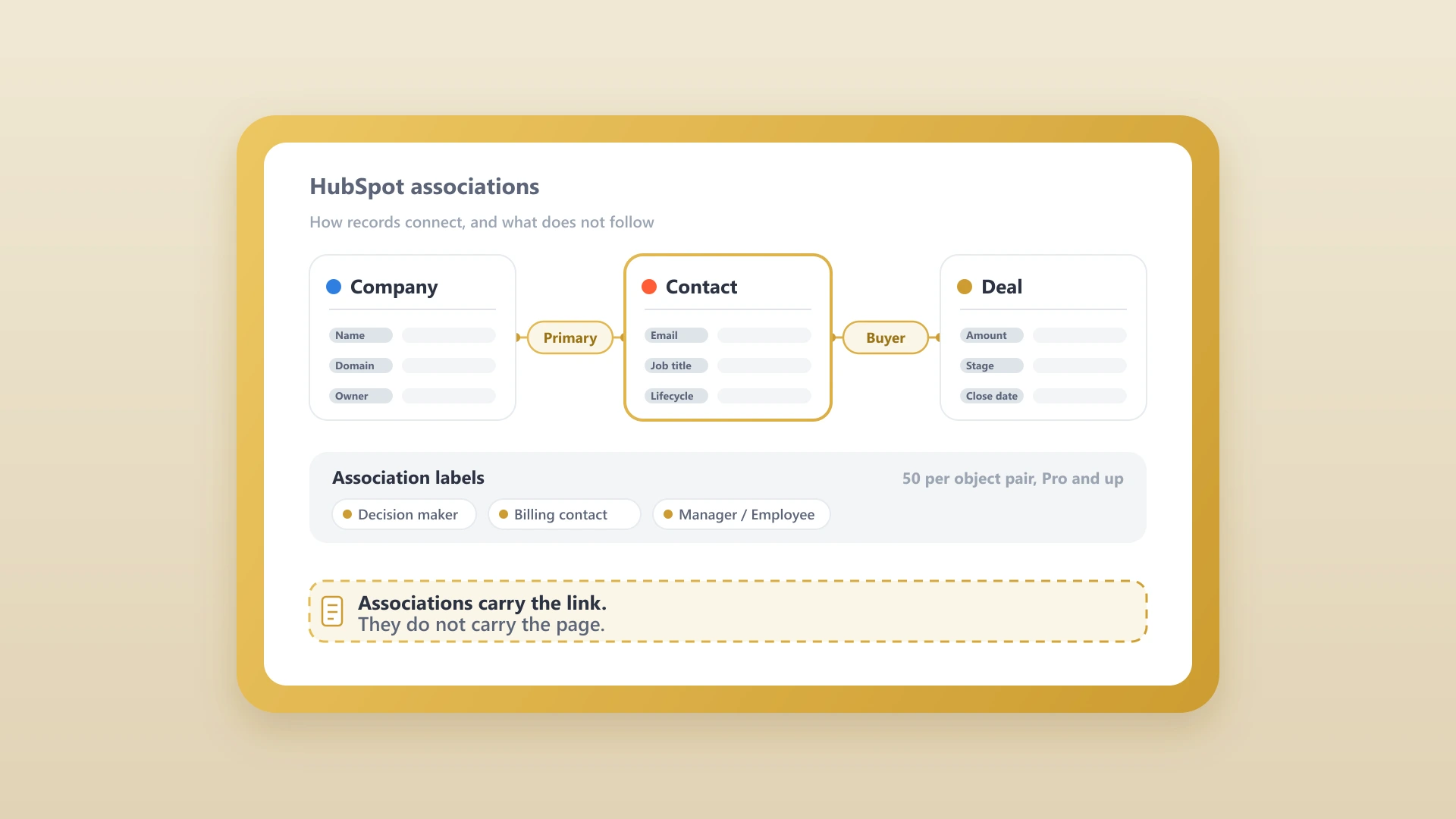
This is worth being precise about, because the intuitive version of this argument is wrong. It is not that HubSpot cannot reach Notion. Notion appears in HubSpot's own documentation as one of the spreadsheet-style apps data sync recognizes, alongside Airtable, Smartsheet, Kintone, and Monday.com, and HubSpot will even suggest an object to map your table onto. The sync works. It just brings across the columns and leaves the page behind, which is the half your reps actually wanted.
Do you need Data Hub?
No cost, no code, native. Set up the sync, let the first pass finish, and stop there. Most small teams never legitimately outgrow this.
Starter for mapping, Professional for programmable automation, webhooks, and duplicate management. Cross the Professional line only when the manual work is measurable.
Notes, account plans, renewal context, research. Nothing to map, nothing to copy, nothing to go stale. This is a different shape of problem and the tier ladder does not address it.
That third card is where a surprising number of Data Hub evaluations should end. If the sentence you started with was that your reps cannot see the account context because it is all in Notion, you are not describing a mapping problem. You are describing a page that needs to be visible on a record.
A custom card is the native mechanism for exactly that: a panel on the contact or deal record that renders data from another system live, at the moment the record loads. Nothing is copied, so there is no conflict rule, no field mapping, no initial sync to wait days for, and no subscription tier gating any of it.
NoteLinker is that card for Notion. Rows appear on the contact whose email matches and on the deal whose name matches, visible by default, so there is no per-row toggle to remember. You can see the shape of it in Notion inside a HubSpot record, and the tradeoff against HubSpot's own tooling is laid out in NoteLinker vs native HubSpot.
Put your live Notion notes on every HubSpot record
No field mapping, no conflict rules, no Data Hub tier required. NoteLinker renders your Notion database rows on the contact and deal record in minutes.
Before you buy a tier
Five questions that settle it faster than a feature matrix
- Write the problem as one sentence. If the sentence contains disagree, duplicate, or always empty, it is a Data Hub problem.
- Run the free tier first. The wall you hit names your tier better than any comparison table.
- Check whether your source table matches HubSpot standard properties before assuming you need custom mappings.
- Price the manual work you are replacing before crossing the Starter to Professional gap. That step is where the cost stops being incidental.
- Ask whether you need the values or the page. If it is the page, no tier on the ladder is the answer.
Data Hub is a good product with a clearer name than it used to have, and the free tier is one of the more generous things HubSpot ships. Use it where it fits: two systems holding comparable records that need to agree. Just recognize the shape of what you are buying. Every tier makes you better at moving fields. When the thing your team is missing is a document, the answer is not a higher tier, it is a live view on the record.