
Sales workflow automation is the end-to-end automation of the multi-step process a rep runs every day: capture a lead, route it to the right person, research the account before the call, capture the notes during the call, log them after the call, create the follow-up tasks, progress the deal stage, hand it off to delivery when it closes. This guide covers the seven workflows worth automating end-to-end, the ones to leave human, the order to build them in, and the cross-tool bridges most teams underinvest in.
The seven workflows worth automating end-to-end
Most useful sales workflow automation falls into seven categories. Most teams will eventually want all of them. The order matters because each one depends on the earlier workflows producing clean data.
1. Lead capture
A new lead enters the system (form submission, demo request, downloaded asset, partner referral) and lands in the CRM with the right fields populated, the right tags applied, and the right owner assigned. No rep manually copying data from a form into the CRM.
Tools: HubSpot's native form to CRM flow handles this cleanly if you are using HubSpot for both marketing and sales. For other stacks, Zapier or Make connect the form tool to the CRM. The complexity comes from data enrichment (looking up company size, industry, technographic data) which usually requires a tool like Clearbit, Apollo, or Clay layered on top.
2. Lead routing
The lead lands and an automation assigns it to the right rep within seconds. Round-robin across the SDR team, territory-based assignment, or product-interest routing depending on the motion. Notification to the assigned rep through Slack or email.
Lead routing overlaps with the CRM automation guide, but the cross-tool angle is the notification step. The routing happens in the CRM; the notification often needs to go to Slack or to the rep's phone, and the round-trip needs to feel instant. Speed matters more than complexity. Sub-five-minute response times convert dramatically better than hour-plus response times, and the gap between the two is almost entirely an automation problem.
3. Pre-call research
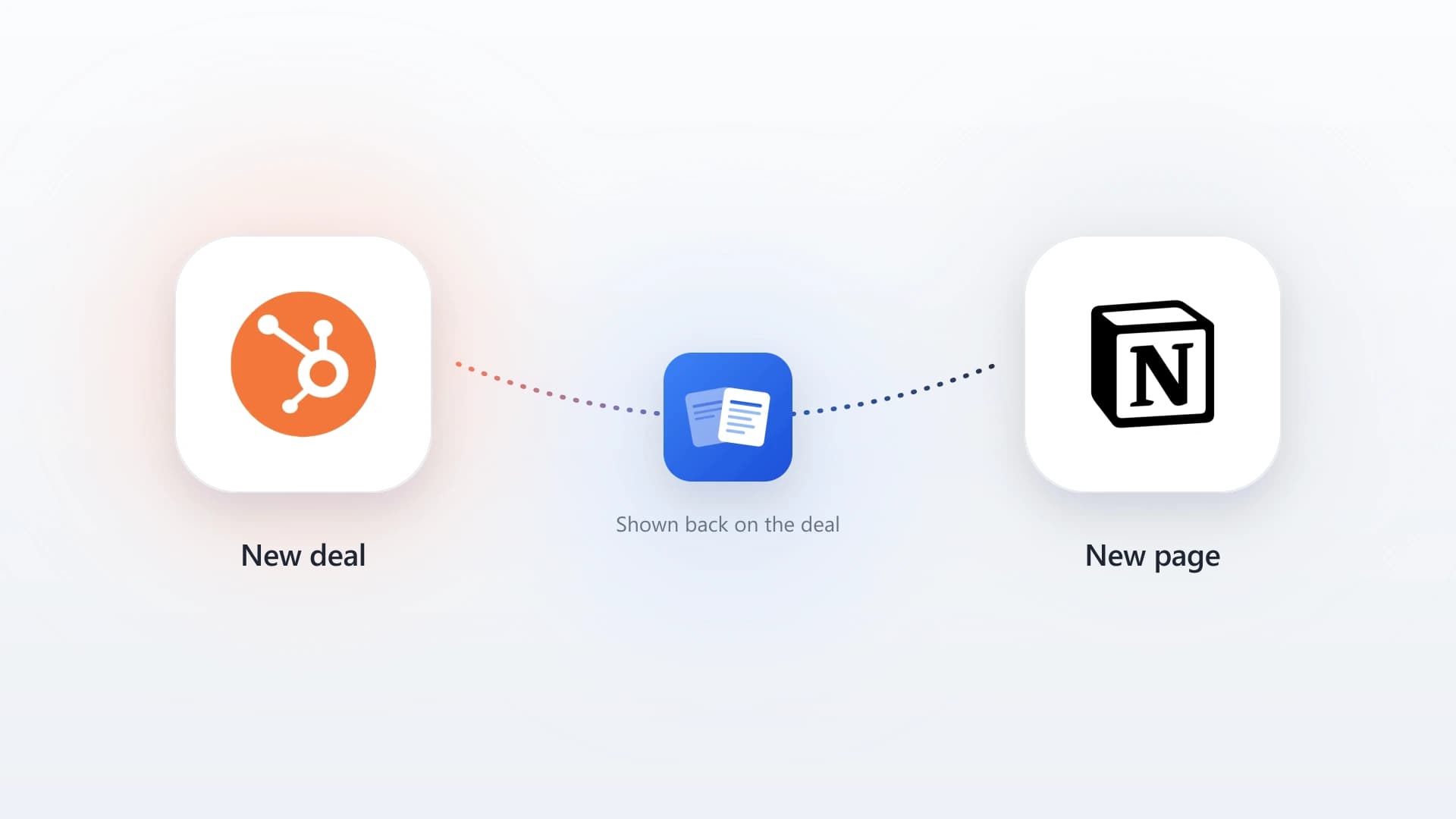
A demo is scheduled for tomorrow. An automation pulls company data (size, industry, recent news), identifies the prospect on LinkedIn, drops a research doc into a Notion database from a template, and links it to the matching HubSpot contact record. The rep walks into the call with the doc already populated instead of starting from a blank page.
Tools: Notion's API plus a serverless function is the most flexible build. For lighter setups, Clay can populate a research doc from a meeting trigger. Apollo and Clearbit handle the enrichment step. The handoff back into Notion is the part most generic automation tools struggle with, because Notion's block model does not play cleanly with Zapier or Make for rich content.
4. Meeting and call notes capture
The meeting happens. An AI notetaker (Granola, Fireflies, Read AI) joins the call, transcribes the conversation, and produces a structured summary. The summary lands in the CRM as a note on the matching contact and deal records. The rep does not write the summary by hand.
Tools: any of the major AI notetakers handle the capture and the CRM-write for the structured summary. The full breakdown of which notetaker fits which team lives in the best AI notetakers for HubSpot guide.
The category most teams miss is the qualitative notes the rep writes themselves: the deeper account analysis, the political dynamics, the strategy thoughts that do not fit in a structured AI summary. Those usually get written in Notion, and the bridge from Notion onto the HubSpot timeline is where most workflow automations break down.
5. Post-call follow-up
The call ends. An automation creates the appropriate follow-up tasks in the CRM, drafts the follow-up email (or sequences it through HubSpot or Apollo), and progresses the deal stage if the call hit specific criteria.
Tools: HubSpot Workflows handle the task creation and stage progression cleanly. The follow-up email drafting is where AI tools (Lavender, Smartwriter) or sequencer-based templates fit.
6. Stage progression and pipeline hygiene
As the deal moves through the pipeline, an automation keeps the record clean: progresses the stage when entry criteria are met, fires reminders when a deal has stalled, creates the next-step task at each transition, and flags deals that have not had activity in 30 days. Covered in more depth in the CRM automation guide.
The workflow-automation angle is the cross-tool piece: the activity that triggers the stage change might be a contract signature in DocuSign, an email reply in Gmail, or a meeting outcome in the notetaker. Each of those needs to trigger the CRM workflow, which means each tool needs an integration that fires fast enough to matter.
7. Sales-to-delivery handoff
The deal closes. An automation kicks off the delivery workflow: creates the project in the project management tool, populates the kickoff doc with content from the deal record and the meeting notes, schedules the kickoff call, and notifies the delivery team in Slack with full context on what was sold and why.
Sales-to-delivery handoff is the workflow most agencies and services teams underinvest in. The sales-to-customer-success handoff post covers the case for getting it right. The single biggest input to a clean handoff is whether the qualitative notes from the sales process are visible to the delivery team, which is a notes-sync problem more than a project-management problem.
In this article
1.
2.
3.
4.
5.
6.
7.
What sales workflow automation actually is
Sales workflow automation is the automation of a multi-step process across whatever tools the steps live in. A workflow is not a single action. It is a sequence of actions that produces an outcome the rep cares about: a lead becomes an opportunity, a meeting becomes a follow-up email, a closed deal becomes a kickoff with the delivery team.
Each step in a workflow lives in some tool. The form is on the website. The lead lands in the CRM. The research happens in Notion. The meeting happens in Zoom with a notetaker recording. The notes get written in Notion (or in the notetaker). The follow-up task lives in the CRM. The proposal gets sent through DocuSign. The kickoff doc lives in Google Docs. The handoff happens in Slack.
A workflow automation removes the manual work between the steps. Without it, a rep spends a meaningful chunk of their day copying data from one tool to another, creating records that should have been created automatically, and remembering follow-ups that should have been scheduled the moment the previous step completed. With it, the rep does the actual work (the conversation, the proposal, the negotiation) and the workflow handles the connective tissue.
The actual hard parts of workflow automation are not the features. They are the gaps between the tools.
The workflows to leave human
Three categories of work where automation usually makes things worse, not better.
The discovery conversation itself
Reps who run discovery from a fully automated questionnaire produce worse fit data than reps who run a structured-but-flexible conversation. Use a meeting note template to scaffold the conversation. Do not automate the conversation itself away.
Negotiation
Pricing pushback, scope changes, and stakeholder objections require judgment that does not encode well into a workflow. Automation can support the negotiation (surfacing similar past deals, drafting redline responses) but should not drive it.
Account strategy
The freeform thinking about a major account, the why-this-deal-will-close narrative, the competitive analysis, the multi-stakeholder map. This is the work that makes a rep good at their job, and automating it produces generic, lifeless analysis that nobody actually uses for decisions. Tools like Notion are good environments for the human writing to happen, but the writing itself should stay human.
The human judgment is the value. Automation should remove the friction around the judgment, not replace it.
The Notion sales workspace setup guide covers the structure that helps without taking over.
The cross-tool gaps where most manual work lives
Most "we need more sales workflow automation" pain is actually a cross-tool gap problem. The CRM has its own automations. The notetaker has its own integrations. Notion has its own automations. The friction lives in the spaces between them, and the spaces are where generic automation tools (Zapier, Make) tend to struggle.
The two cross-tool gaps that consistently cause the most pain:
The notes gap
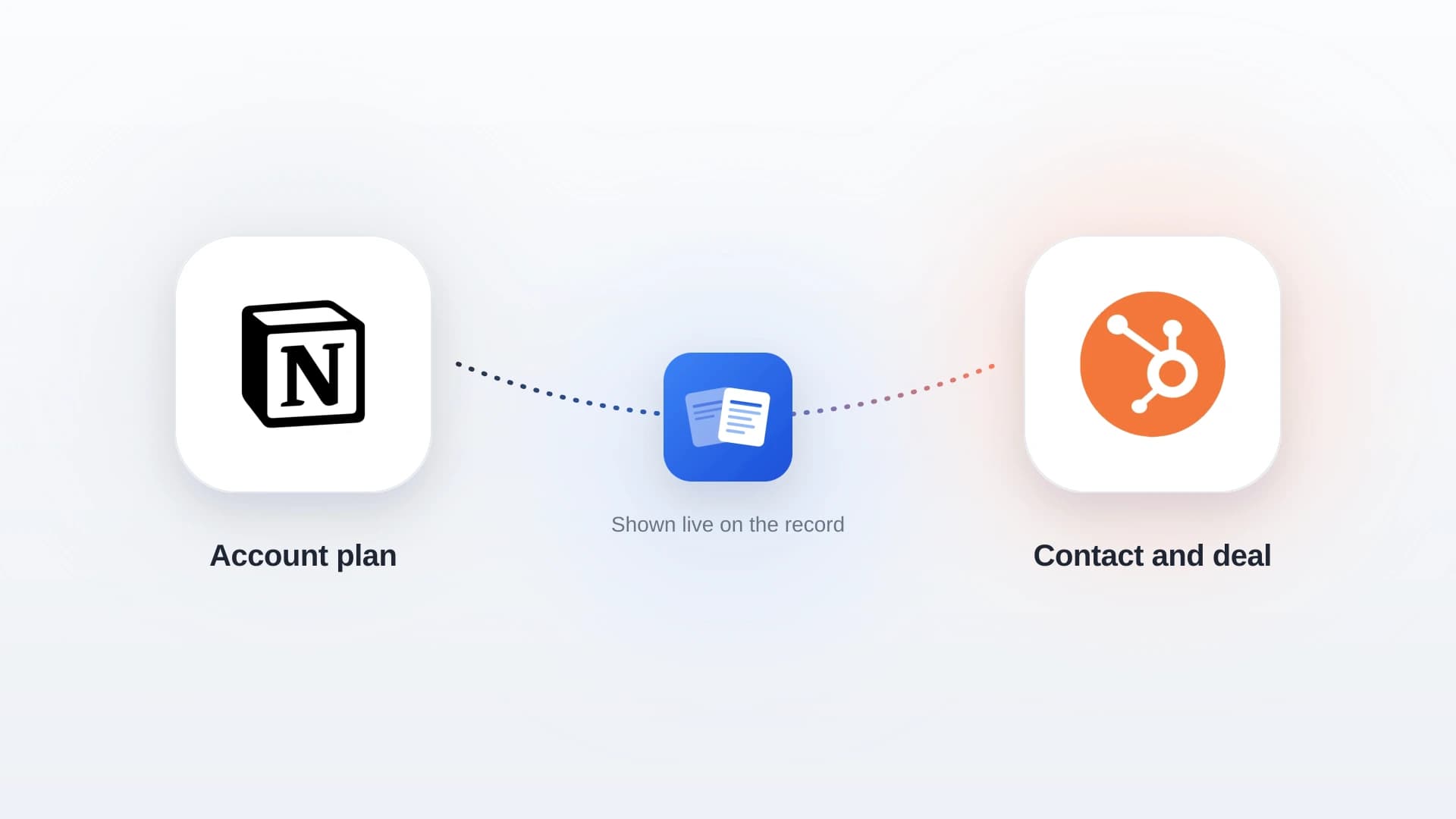
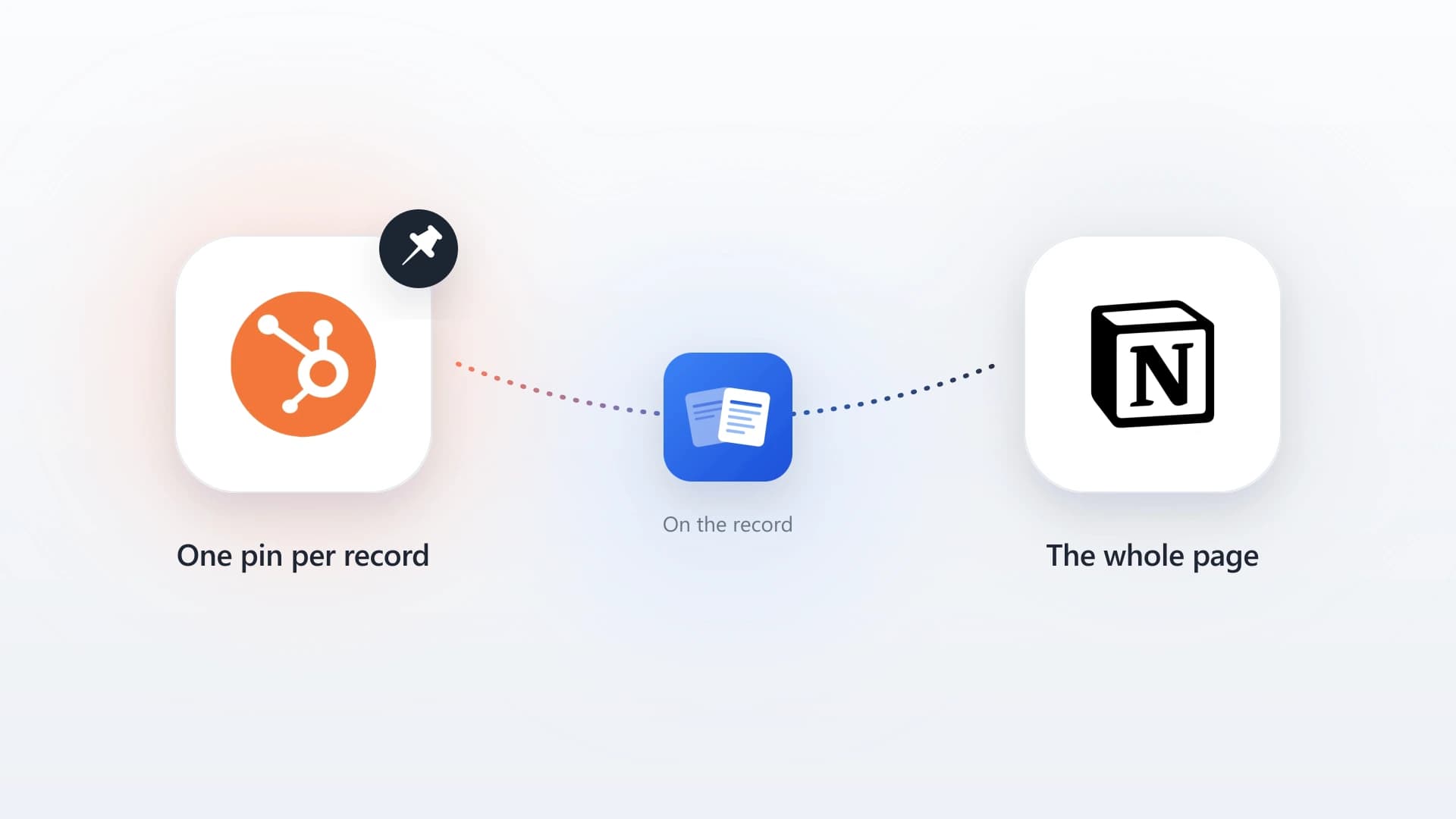
Reps write detailed notes in Notion (because Notion is a better writing environment than any CRM), but the CRM, where the rest of the team looks for context, has none of those notes. Zapier and Make can move text between the two, but they strip or mangle the formatting because Notion's block model does not translate cleanly. The cleanest fix is a purpose-built tool. For the specific Notion-to-HubSpot case, NoteLinker handles this without a Zapier subscription: a Sync to HubSpot checkbox in any Notion row pushes the formatted page onto the matching HubSpot contact or deal timeline.
The handoff gap
The deal closes in the CRM, the delivery team works in a different project management tool, and the qualitative context (what the prospect actually said, what they want, what they are sensitive to) does not survive the transition. The structured data (deal value, close date, primary contact) makes it through. The qualitative context does not, because nobody has automated the part of the workflow that moves it.
Both gaps are solvable, and the solution is rarely "add another Zap." It is usually either a purpose-built tool for the specific pairing or a tighter integration between the two tools at the platform level.
Purpose-built sync
- Preserves headings, bullets, and bold text
- Built for one pairing, so it just works
- No multi-step Zap to maintain or debug
- Lands the note on the right timeline as a readable activity
Generic Zapier or Make
- Moves plain text but strips rich formatting
- Notion's block model does not translate cleanly
- Breaks quietly when either tool changes its API
- Often produces a wall of unformatted text
Close the Notion-to-HubSpot Workflow Gap
NoteLinker pushes formatted Notion notes onto matching HubSpot contact and deal timelines automatically, so the qualitative context survives the rest of the workflow.
The order to build them in
A practical build sequence that holds up. Each step assumes the previous one is producing clean data.
- 1
Lead capture and routing
Without these, every other workflow runs on leads that took 24 hours to land in the CRM and 24 more to get assigned. The leverage on response time is too high to leave on the table.
- 2
Meeting and call notes capture
The notetaker integration is the highest-ROI piece. Once notes are landing in the CRM automatically, the rest of the workflow has the data it needs to fire intelligently.
- 3
Post-call follow-up workflows
Now that meeting notes are flowing, the task-creation and email-drafting workflows have the context they need.
- 4
The notes-sync bridge
Connect Notion (or whatever writing tool reps prefer) to the CRM. This is the workflow most teams skip and the one that determines whether qualitative context survives.
- 5
Stage progression and pipeline hygiene
With activity data flowing reliably, the stage-progression and hygiene workflows can trigger on real signals instead of stale ones.
- 6
Pre-call research automation
A nice-to-have that pays off only once the upstream data is clean enough to populate a research doc usefully.
- 7
Sales-to-delivery handoff
Last, because it depends on every prior step: clean records, logged notes, and synced qualitative context.
Teams that build these in reverse (handoff automation before lead capture) end up with sophisticated downstream workflows running on incomplete upstream data, which is worse than no automation.
How to know a workflow automation is working
The metric that matters is whether the manual work the automation was built to eliminate is actually getting eliminated. Two ways to verify.
Verifying a workflow actually landed
- Ask the reps directly. If a notes-capture workflow is in place, the answer to "how often do you manually copy notes into the CRM" should be "never."
- Check whether reps still do the work for certain cases. "Still doing it for some calls because the automation misses certain meeting types" means the automation is not finished.
- Watch time-from-form-submit to first-rep-touch. A working lead-capture workflow produces a measurable drop.
- Watch time-from-meeting-end to logged-note. A working notes-capture workflow produces a measurable drop.
- Watch time-from-deal-closed to delivery-kickoff. A working handoff workflow produces a drop here. If the numbers do not move, the automation is not pulling its weight.
The workflows that consistently move the numbers are the boring ones. Lead capture. Notes logging. Follow-up task creation. Notes sync between the writing tool and the CRM. The flashy workflows (AI-powered next-best-action recommendations, autonomous email sending) almost never produce measurable lift in their first year, and most never produce it at all.
Sales workflow automation is not a platform feature. It is a sequence of small, boring automations built in dependency order.
Each one removes a specific piece of cross-tool friction, with the human judgment work explicitly protected from being automated away. Build it that way and reps will spend less time on coordination and more time on the conversations that close deals. Build it the other way and you will spend the next year debugging workflows that never produced any lift in the first place.