
Search for an Airtable HubSpot integration and you will find plenty of pages listing options. Almost none of them mention the fact that decides everything else: Airtable does not sync HubSpot. HubSpot syncs Airtable.
That sounds like a pedantic distinction. It is not. It determines which plans you need, which direction data can flow, whose support team owns the problem when it breaks, and why the pairing feels lopsided compared with the other integrations in Airtable's menu.
In this article
1.
2.
3.
4.
5.
6.
7.
8.
9.
1. Airtable's native sync does not include HubSpot
Airtable has a real, first-party sync feature. You can create a table whose rows are pulled from an outside system and kept current automatically. The supported sources are Box, Google Drive, Google Calendar, GitHub Issues, GitHub Pull Requests, Miro, Emailed Data, the Sync API, Tableau Online, Jira Cloud, Salesforce, Zendesk, Jira Server and Data Center, and Adobe Experience Manager.
HubSpot is not on that list. Salesforce is.
Two other properties of Airtable's native sync are worth knowing even though HubSpot cannot use them, because they set expectations for what "sync" means in Airtable's vocabulary. First, direction: sync integrations are always a one way sync from the external application into an Airtable base, so changes made inside Airtable never travel back out. Second, plan gating: the everyday sources sit on all paid plans, while the premium set that includes Salesforce, Zendesk, Jira Cloud, and Tableau is restricted to Business and Enterprise Scale.
So even in the parallel universe where Airtable did support HubSpot natively, it would be read-only into Airtable and would likely sit on the most expensive tiers.
2. Both official routes are built by HubSpot
Because Airtable does not reach out to HubSpot, HubSpot reaches in. Airtable's own documentation describes it plainly: HubSpot offers two tools, Workflows and Data Sync, that connect with Airtable via Airtable's API.
That means the integration lives in your HubSpot portal, is configured there, is billed against your HubSpot plan, and is supported by HubSpot. Airtable is explicit that its own help team stops at the boundary, noting that 1:1 support for integrations with third-party tools is limited in support interactions.
The integration is a HubSpot feature that happens to point at Airtable, not an Airtable feature that happens to point at HubSpot. Budget and troubleshoot accordingly.
Route A: the HubSpot Data Sync app
This is the two-way option, built by HubSpot, with roughly 5,000 installs. Data is shared between Airtable and HubSpot in real time rather than on a polling schedule, which is the main thing it has over the alternatives.
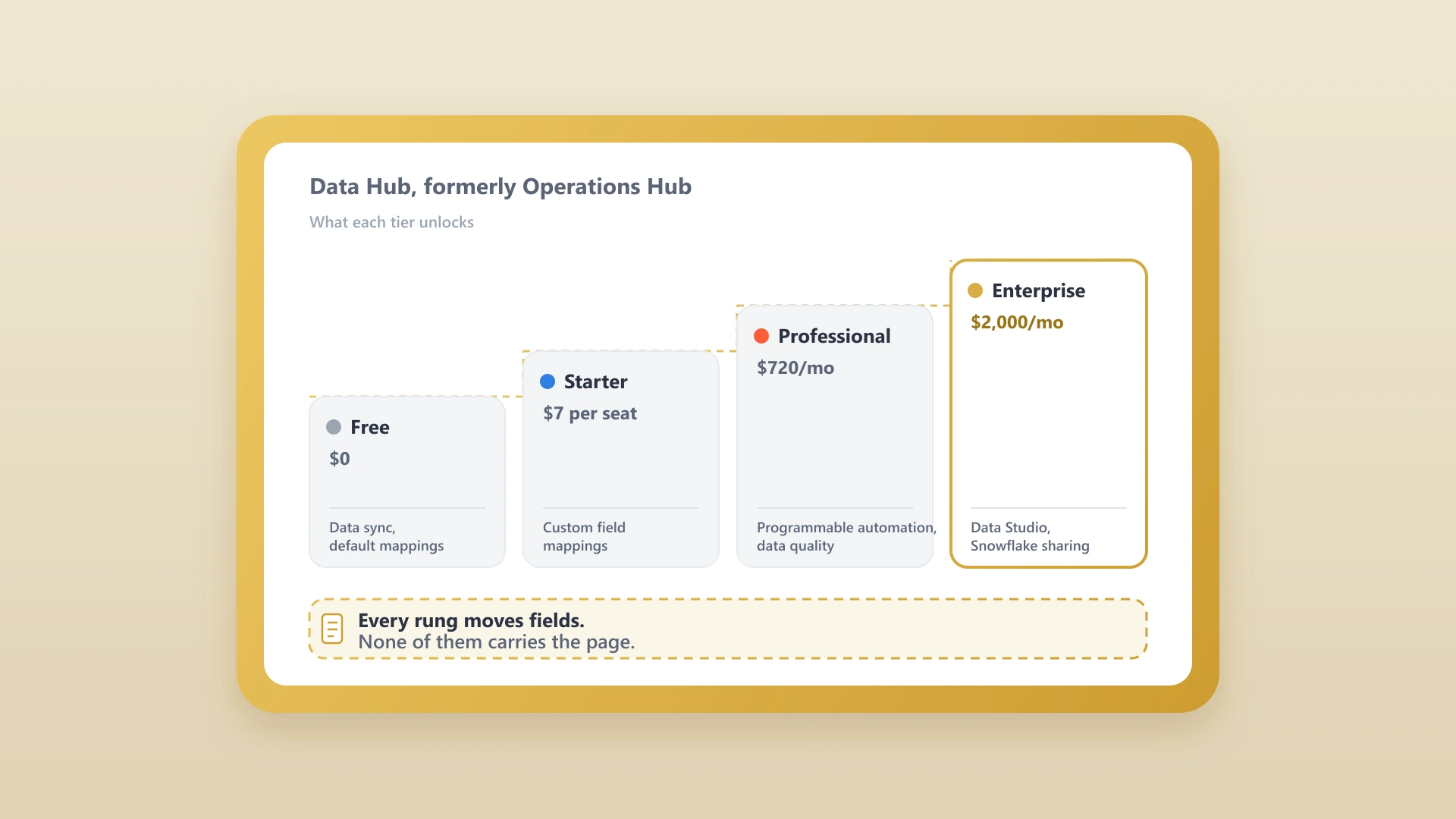
The catch is the plan gate. The app is free to install but requires a paid subscription to Data Hub Starter, which is HubSpot's data tooling tier. A free HubSpot portal cannot run it at all, so the honest cost of this route is a HubSpot upgrade rather than an app fee.
It also has real setup requirements on the Airtable side. Your Airtable table needs a Last modified time field so the sync can tell what changed, and text you want to land in a HubSpot property should be a Single line text field rather than something more exotic. When you are syncing contacts specifically, the table also needs an Email field set to the email format, because that is the identifier the match is built on. Company records do not carry that requirement.
Route B: the Airtable workflow action
The second HubSpot-built app is narrower and simpler. It adds an Airtable action to HubSpot workflows, so when a workflow runs it creates a new row in an Airtable table. Around 2,000 portals have it installed.
Two limits define it. It is one direction only, and Airtable's documentation states the consequence without hedging: this process is one-way, meaning that changes made in Airtable will not update back to HubSpot. And the mapping is capped, letting you send up to ten HubSpot properties into Airtable column headings.
For the specific job of creating Airtable records from new HubSpot deals, that is a good fit, because creating a row in one direction is precisely what it does. For anything resembling ongoing synchronisation, it is the wrong tool.
Pros
- Genuinely two-way and real time (Data Sync)
- Free to install, both apps
- Built and supported by HubSpot itself
- Workflow action is the shortest path for one-way record creation
Cons
- Data Sync requires paid Data Hub Starter
- Workflow action caps at ten mapped properties
- Both apps are rated well below the marketplace norm
- Airtable support will not troubleshoot either one
3. The ratings are the part worth reading
Marketplace ratings are usually a weak signal because happy users rarely review anything. They are worth reading here because both HubSpot-built Airtable apps sit far below where first-party apps normally land.
Reviewers of the Data Sync app report duplication showing up in synced data and trouble once field mappings move beyond plain text into formulas. Reviewers of the workflow app report that fields with dropdown options lack custom mapping, and that deal stage changes need adjustments on the Airtable side before they fire reliably.
None of that makes either app unusable. It does mean you should pilot on one object with a handful of records before pointing either at a production table, and it explains why a third-party category exists at all for a pairing that already has two first-party apps.
4. Third-party sync tools, and the billing unit that decides the price
When the official apps do not cover the objects or the direction you need, the general-purpose sync tools do. The feature grids across them look similar. The pricing models do not, and that is the comparison that actually changes your bill.
Whalesync bills for records held in sync
A standing charge on the size of the dataset. HubSpot sits on the Plus tier rather than the entry plan, which starts at $80 per month for 5,000 records in sync. Records are not double counted across the two connected apps, so a table costs what its row count suggests.
Unito bills on a formula and publishes no self-serve price
Cost is built from the tools you connect and the items kept in sync, and items count on both sides of the pair, so one 500-row table can be billed as 1,000 items. You will need a sales conversation to get a number.
Zapier bills per task executed
A metered charge on activity rather than on data volume. Cheap when records change rarely, expensive when they change constantly, and the inverse of how the sync engines price the same workload.
The rule of thumb: if your Airtable table is large but quiet, per-record pricing wins. If it is small but busy, per-task pricing wins. Size the two against your actual change volume rather than your row count, because that is where the estimates usually go wrong. We break the numbers down further in our guides to Whalesync pricing and Unito pricing, and in our Zapier alternative comparison.
The only first-party two-way option, real time, and no extra vendor in the stack. Pilot the objects you need before you rely on it.
The simplest route by a wide margin, and free. One direction only, so do not plan on edits travelling back.
More capable and more expensive. Choose on the billing unit, not the feature grid.
5. Airtable HubSpot CRM integration: decide who owns the record first
Most of the pain in this pairing is not technical. It comes from connecting two systems that both believe they own the customer.
Airtable is an excellent relational database and a mediocre CRM. HubSpot is an excellent CRM and a rigid database. Teams reach for this integration precisely because they want both, and then wire the two together as peers, which means every conflicting edit becomes a question the sync tool has to answer and cannot.
- Name one system as the source of truth for each object before configuring anything.
- Let HubSpot own contacts, deals, and pipeline, since that is what its reporting is built on.
- Let Airtable own the operational tables HubSpot models badly, such as inventory, production, or delivery.
- Connect on a stable identifier, usually email for contacts, and confirm the field format matches what the sync requires.
- Sync the minimum set of fields rather than mirroring whole objects in both directions.
A narrow sync between two systems with clear ownership is durable. A wide sync between two systems that both claim the record will need babysitting forever, whichever tool you picked.
6. What none of these routes carry
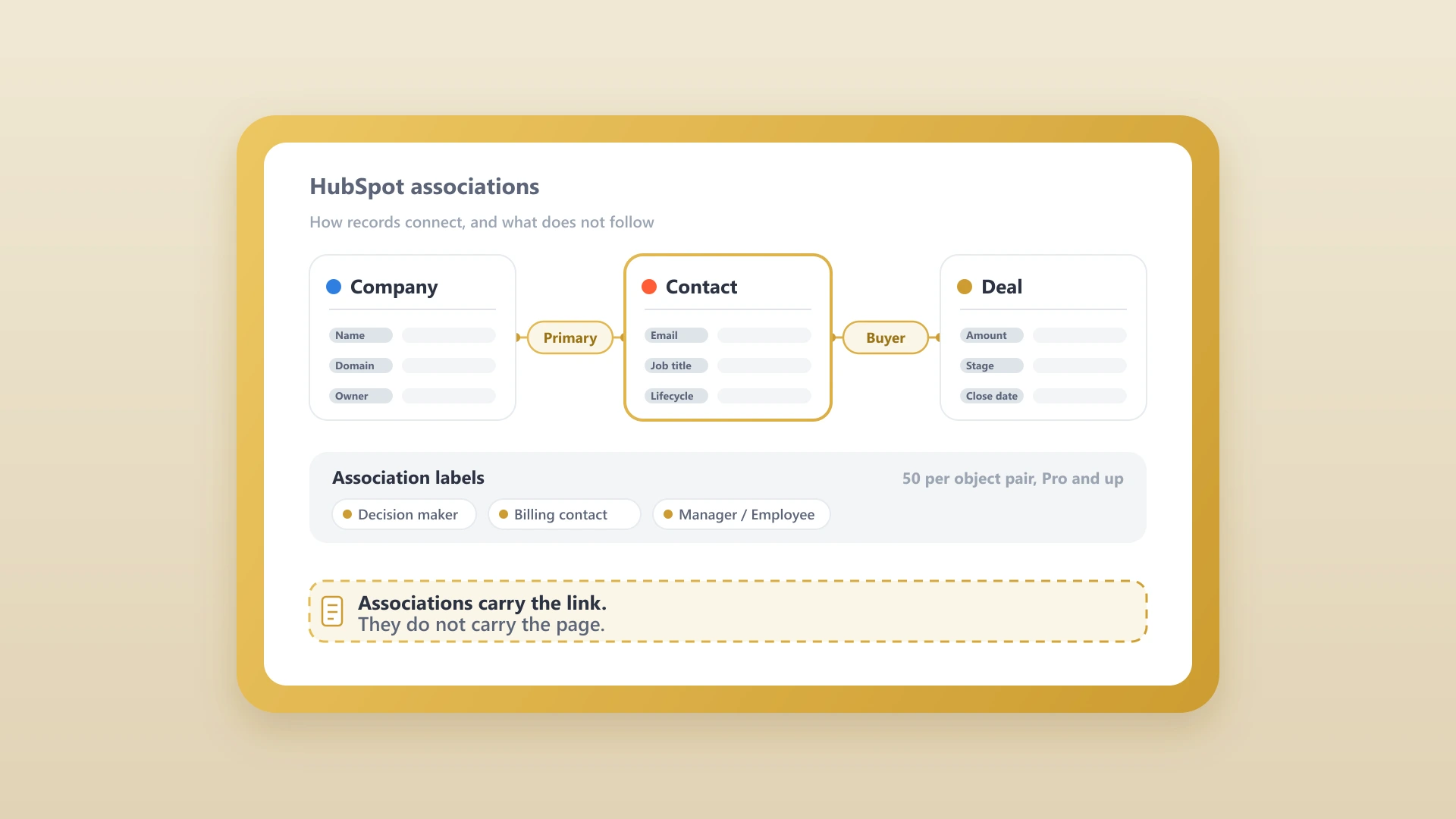
Every option above moves field values. A cell in Airtable becomes a property in HubSpot, or the reverse. That is the entire job, and within that job the tools work.
What none of them move is the long-form context. The account brief, the discovery write-up, the implementation plan, the meeting notes: the material your team actually wrote. Those live in a document, not in a column, and field sync has nothing to say about them. You can sync a "Last call summary" text field and watch the formatting flatten into one grey paragraph, which is usually the point at which people stop bothering.
Record creation and context visibility are two different problems. Almost every integration on this page solves the first one and leaves the second untouched.
This is the same split we describe in our guide to the Notion HubSpot integration, and it is not specific to Airtable. Any time a database tool meets a CRM, the fields are the easy half.
The fields sync. The write-up does not.
NoteLinker renders your live Notion pages on the matching HubSpot contact and deal, formatting intact, so the brief and the notes stay visible where the deal is worked. No export, no flattening, no second tab.
7. Airtable or Notion for this job?
If you are still choosing the workspace rather than the connector, choose on what your data actually is.
Airtable wins when the records are genuinely relational and numerous, and when different people need to filter the same table many different ways. Notion wins when the record is mostly a document and the fields are metadata around it, which is the usual shape for account research, call notes, and project briefs.
Neither has a native HubSpot sync, so the connector decision looks similar either way. For the fuller comparison see Airtable vs HubSpot and Notion vs Airtable.
Getting this live without regret
Start by deciding direction, because it eliminates most of the menu immediately. If you only need HubSpot events to produce Airtable rows, the workflow action is free and you are finished this afternoon. If you need edits to travel both ways, you are choosing between the Data Sync app and a third-party tool, and the Data Sync app is only a real option if Data Hub Starter is already in your budget.
Then pilot narrowly. One object, one small table, a handful of records, and a week of watching. Both first-party apps have enough reviewer reports of duplication and mapping trouble that a pilot is cheap insurance, and the failure mode you care about is the one that shows up on the hundredth record, not the first.
Finally, be honest about what remains unsolved after the sync is green. The columns will match. The document your team wrote will still be somewhere else, and that gap is worth closing separately rather than pretending a field sync will eventually cover it.