
If you run a sales team, you have probably had this exact debate at least once. Half the team wants to live in HubSpot, where the pipeline lives, the deals get tracked, and the forecast comes from. The other half wants to live in Notion, where they actually write, plan, and think. Someone in the room frames it as a choice, the conversation gets stuck on which tool is better, and the team ends up half committed to both and fully committed to neither.
The HubSpot vs Notion comparison is one of the most searched questions in sales tooling, and almost every result on the page treats it as a fight between two products that solve the same problem. They do not. HubSpot is a CRM. Notion is a workspace. The reason teams keep ending up with both is that neither tool can do what the other one does well, and the right answer is usually to stop choosing between them. This guide walks through what each one is genuinely built for, where each one falls down, and how to set up a workflow that uses both without forcing your reps to copy-paste between them all day.
In this article
1.
2.
3.
4.
5.
6.
7.
8.
9.
10.
What HubSpot is built for
HubSpot is a CRM, and almost every design decision in the product flows from that. Contacts, companies, deals, and activities are first-class objects with structured properties, and everything else in HubSpot wraps around those objects. Pipelines are kanban views over deal records. Forecasts roll up structured deal-stage data. Workflows trigger off property changes. The activity timeline on a contact page is the historical log of every email, call, meeting, and note attached to that record.
This structure is what makes HubSpot good at the things a sales manager actually has to do. You can ask "which deals are slipping this quarter," "which reps are behind on follow-ups," or "what is our average sales cycle for mid-market accounts" and get an answer because the underlying data is structured. The AI features that have rolled out across HubSpot in the last two years lean on the same structured data, which is why they get useful answers about your pipeline that a generic chatbot cannot. HubSpot is also where the rest of your go-to-market motion meets the deal: marketing attribution, customer success handoffs, support tickets, and renewal tracking all hang off the same contact and company records.
What Notion is built for
Notion is a workspace, and its design optimizes for the opposite set of problems. The unit is a page, not a record. A page can be anything: a long-form writeup, a database, a kanban board, a meeting agenda, a wiki, or a freeform doc with embedded toggles and callouts. The product gets out of your way when you want to think, write, and structure information however the work demands.
For a sales team, this is exactly what you need for the parts of the job that happen outside the CRM.
Account research
The deep dives on a target account that do not belong in an activity log live naturally in a Notion page.
Discovery call prep
The questions, hypotheses, and angles a rep wants to test fit a free-form page far better than a CRM field.
Deal-room collateral and competitive notes
Longer artifacts and competitive intelligence are built and refined where writing is comfortable.
Post-call synthesis
The place a rep figures out what they actually learned and what to do next is a page, not a record.
A good rep is doing real thinking on every account, and that thinking does not fit inside the constraints of a CRM activity entry. Notion is also built for sharing. A page can be opened by the whole team, commented on, and updated collaboratively. Sales managers can review an account strategy without scheduling a meeting. New AEs can read the full history of an account before their first call. None of this is possible if the content lives only in someone's HubSpot notes field, and most of it is not really possible inside HubSpot at all.
HubSpot vs Notion at a glance
The short version, side by side:
| Tool | HubSpot | Notion |
|---|---|---|
| Best for | CRM, pipeline & forecasting | Writing, research & strategy |
| Strengths | Structured data, reporting, automation | Flexible pages, collaboration, fast capture |
| Weaknesses | Poor for long-form notes | No pipeline reporting |
| Pricing starts at | Free, paid from $20/seat | Free, paid from $10/seat |
| Used by | Whole revenue team | Reps and knowledge workers |
Reading that table, the question almost answers itself. The two tools do not really overlap on the things they are best at. They are not substitutes for each other.
You are looking at two tools that each do half the job extremely well, and the actual decision is how to combine them.
When teams pick HubSpot only and what breaks
Plenty of sales orgs commit to HubSpot and try to do everything inside it. The pipeline gets tracked properly, the forecast works, and the manager can see who has done what. So far so good.
What breaks is the writing. Reps end up keeping their account notes in a Google Doc, a personal Notion workspace, or worst of all, in their head. The HubSpot timeline gets sparse activity logs that say things like "good call, will follow up next week," which tells a future reader almost nothing. When the deal stalls or the account churns, no one can reconstruct what actually happened, and the reasoning that led to the decisions gets lost. The CRM ends up looking organized but shallow, which is one of the five signs your sales notes are trapped in Notion silos, even when the team is technically not using Notion at all. The problem is the same: the real notes are not in the CRM.
When teams pick Notion only and what breaks
The other version is teams, often early-stage, that try to run their entire sales motion out of Notion. The argument is usually some variant of "we already use Notion for everything, we will just add a contacts database and skip the CRM." It works for a quarter, sometimes two.
Then the team grows. The contacts database gets bigger and slower. The kanban board for deals does not roll up to a forecast. There is no way to track which emails went out to which prospect because Notion does not see your email. There is no lead scoring, no rep performance reporting, no integration with the dozen other tools the rest of the company uses. Eventually someone tries to put together a board update on pipeline health and discovers that the data needed for the answer is not actually in Notion, it is scattered across notes that have to be read one at a time. At that point the team buys HubSpot, and the question becomes how to migrate without losing the months of context already in Notion.
Picking one tool gets you
- A single place to train the team on
- One subscription per rep instead of two
- No bridge to build or maintain
- A simpler stack on paper
Picking one tool costs you
- HubSpot-only: a CRM full of shallow one-line activity logs
- HubSpot-only: real account thinking trapped in docs and reps' heads
- Notion-only: no forecasting, reporting, or pipeline roll-up
- Notion-only: a painful migration the moment the team grows
Why "HubSpot vs Notion" is the wrong question
The reason this comparison keeps showing up is that people are trying to figure out which tool to commit to. The honest answer is that the question itself sets up a false choice. You are not deciding between two products that do the same thing badly. You are looking at two tools that each do half the job extremely well, and the actual decision is how to combine them.
The teams that handle this best treat Notion as the place where work gets thought through and HubSpot as the place where work gets recorded. The rep writes the discovery prep, the post-call synthesis, and the account strategy in Notion. The structured outcome of that work, the activity log, the next-step date, the deal stage, lives in HubSpot. We made the long-form version of this argument in why Notion is the best environment for strategy and HubSpot is the best for execution, and the practical version in why HubSpot and Notion are the perfect combo for your business. Once a team accepts this split, the only remaining question is how to keep the two sides connected without forcing reps to copy-paste between them every day.
This is the system of record for everything the whole revenue team relies on to see what is happening with deals.
This is where reps actually think, write, and plan before and after every call.
Run Notion for thinking and HubSpot for recording, with NoteLinker pushing the notes from one onto the timeline of the other.
How to use HubSpot and Notion together
There are a few practical ways to combine the two tools, and the right answer depends on how much of the workflow you want automated.
- 1
Start with HubSpot's native Notion embed
The most common starting point lets you view a Notion page from inside a HubSpot record, which is useful for surfacing context without leaving the CRM. The catch is that the embed is read-only and does not push Notion content onto the HubSpot contact or deal timeline. The activity log stays empty, which is the part the rest of the team actually looks at.
- 2
Try general automation if you want more
Using a tool like Zapier or Make to watch a Notion database and push new pages into HubSpot is technically possible but practically painful, because the Notion API returns pages as nested block trees that have to be reassembled into something HubSpot can render. Most teams that try this end up with broken formatting, brittle workflows, or maintenance burden that grows over time.
- 3
Use a purpose-built sync tool
NoteLinker is built specifically for this problem: connect your Notion workspace to HubSpot once, and from then on every Notion page you want on a HubSpot timeline gets there with a single click, with formatting preserved. The rep keeps writing in Notion the way they always have. The CRM gets the full picture instead of the half version.
We laid out the full integration landscape in the complete Notion HubSpot integration guide, and the step-by-step setup in how to sync Notion notes to HubSpot CRM automatically.
Stop choosing between HubSpot and Notion
NoteLinker syncs your Notion notes onto the HubSpot timeline in one click. Keep writing where you think best, and let your CRM stay complete. Two-minute setup, free trial.
Pricing comparison
For most small to mid-sized teams, the cost difference between HubSpot and Notion is not the deciding factor, but it is worth knowing.
HubSpot
A free tier covers basic CRM functionality and is genuinely usable for early-stage teams. Sales Hub Starter is currently around $20 per seat per month, with Professional and Enterprise tiers above that for the features larger teams need.
Notion
A free personal tier covers individuals, and the Plus plan is around $10 per seat per month, with Business and Enterprise tiers for larger workspaces.
The bridge
If you are running both, you are paying for two seats per rep, plus the cost of whatever connects them. NoteLinker is a flat $19 per month (or $15.83 per month billed yearly), a small line item compared to either platform and far cheaper than the engineering time required to maintain a custom integration.
Final verdict
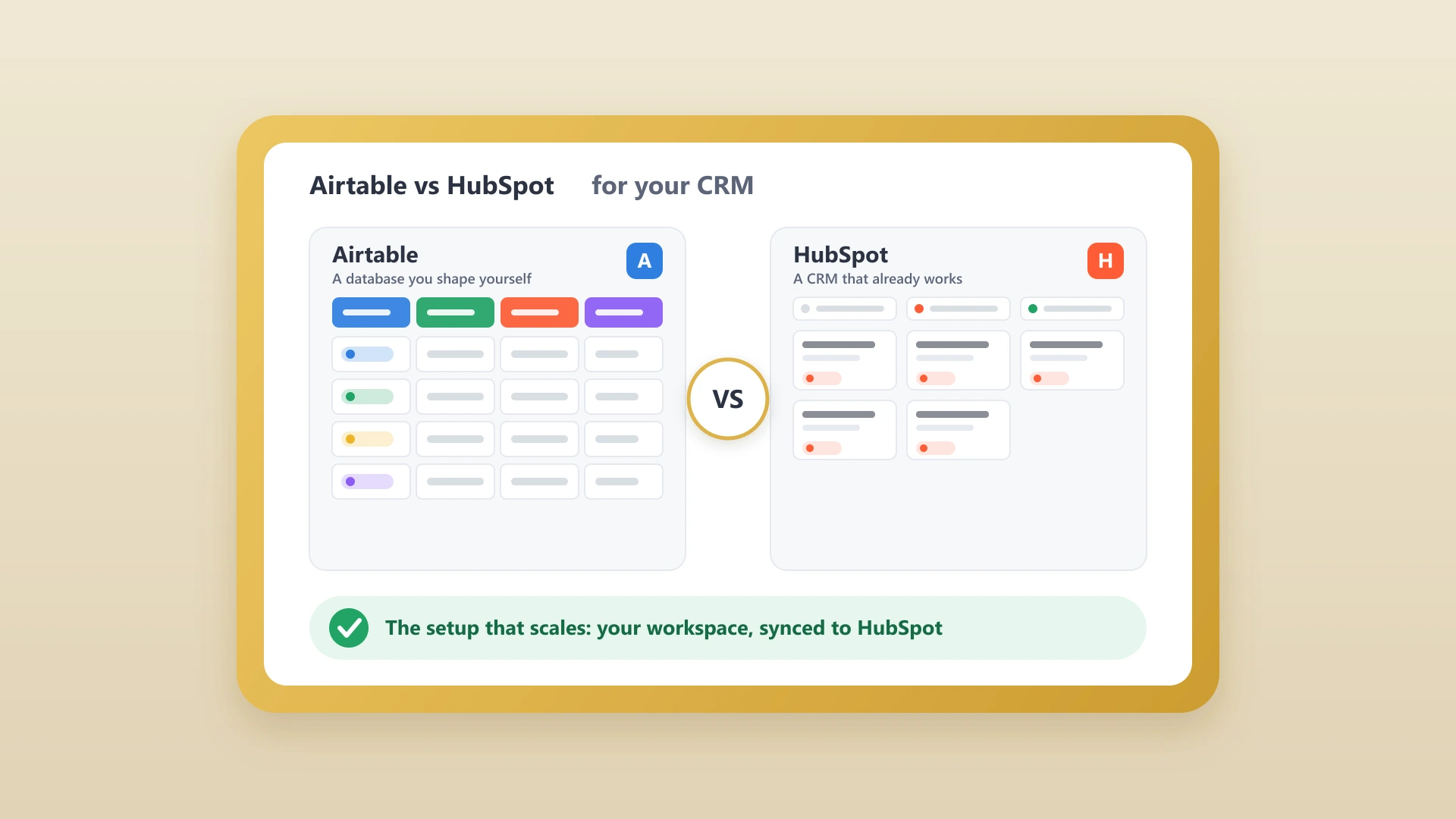
HubSpot vs Notion is the wrong frame. The right frame is HubSpot and Notion, with a sync layer between them that keeps the CRM honest. Pick HubSpot for the structured CRM work that the whole revenue team relies on. Pick Notion for the writing, research, and strategy that does not fit inside a CRM. Then connect them so the work your reps do in Notion ends up on the HubSpot timeline where everyone else can see it.
The teams that try to make one tool do both jobs end up either with a CRM full of empty notes or a Notion workspace that cannot answer basic pipeline questions. The teams that use both, with NoteLinker handling the bridge, get the writing environment reps actually want and the CRM the rest of the company actually needs. That is the version that scales.